

I don’t want to minimize the myriad of very real health challenges many women live with. However, I do want to bring attention to the reality that most of us don’t drink enough water and it’s making us feel sick. Don’t worry, this isn’t an article that’s going to shame you for your lack of this essential substance. What I am going to do is share more on the topic of how the unfortunate situation of dehydration that many of us find ourselves in, could absolutely be the cause of many of the day to day discomforts that we live with.
Hydration is really a tough one because there are so many other things we can choose to drink besides water. But water is the only one of those choices our body actually wants and needs. What happens is over time is we sort of become accustomed to a certain level of chronic dehydration. That’s why when ominous health signs and symptoms creep up, we often don’t relate it to our inadequate water intake. Our body does it’s best to function at full capacity even when its basic needs aren’t being met.
It sounds like classic relationship issues, right? Well, it kind of is! But let’s consider a simple houseplant scenario instead. Over time our body tissues start to dry out like the soil of a parched houseplant. Have you ever tried to water a houseplant that has been over-neglected? What happens? The water just runs down the sides and right out the bottom. Hardly anything was absorbed… Our body tissues are like that in a way. That’s why when we try to increase our water intake, we may feel like have to pee constantly. Then we’re like, “Well if this is how it’s going to be it’s definitely not going to work!.” Trust me, I get it. It’s inconvenient when we’re in the middle of all the amazing stuff we do!
The good news is, like any great relationship, after the initial run-off stage, things start to shift big time. It’s like the houseplant that’s soil finally gets saturated and moist and the leaves start looking lustrous and perky again… Also, not to worry because generally the need to frequently urinate becomes less over time, as the body and organ tissues are slowly quenched of thirst. There can also be more noticeable positive side effects. I’m sure most of us would say yes to more energy, improved sleep, better memory, clearer thinking, smoother and plumper skin, hair that shines, muscles and joints that recover much quicker from exercise and ache less. And, what’s more is one of the biggest benefits that I haven’t even mentioned yet, we’d like to have more balanced hormones and all the positive side effects that comes from that!
Let’s go into that last positive side effect a little more because as we know, hormonal balance is so dang important to us lady folk. I recently read an article called What Every Woman Needs to Know About Hydration by Berne Broudy. The author points out that many of the standard recommendations for water intake are designed for men. Hydration isn’t as simple as just adding water. In fact, women have a special set of requirements. Stacy Sims, Ph.D., states that “Women are not small men.” That’s an essential observation because our unique physiology means our water requirements are different than men. And if we drink water according to common standards, we may be functioning at less than our optimum performance.
It primarily has to do with blood volume. Water maintains blood circulatory pressure by supplying volume to the plasma. When water intake is low, blood volume decreases which can effect the blood supply of several major organs including the liver and kidneys. Since most hormones in our body are metabolized by the liver and excreted by the kidneys, a disturbance in the function of these organs can directly lead to impaired metabolism and excretion of hormones.
Because the breakdown of hormones is impaired, there’s a higher concentration in the system. This causes hormonal feedback signals to be inhibited so that new functional hormones are not released into circulation. This also causes a buildup of toxins in the system which most glands are very sensitive to. Additionally, poor tissue hydration can effect the detoxification of tissues and further leads to glandular dysfunction and hormonal imbalances.
What’s more, for women who are on their period, drinking enough water throughout the day is especially important due to the loss of fluid, making dehydration easier. Adequate water intake can also help alleviate back pain and cramps as well as help buffer energy slumps. And contrary to how it may seem, drinking more water on your period helps alleviate gas and bloating by flushing out the system. Dehydration can also be the cause of period headaches because not having enough water actually causes the brain to pull away from the skull leading to a throbbing headache, and can potentially trigger a migraine.
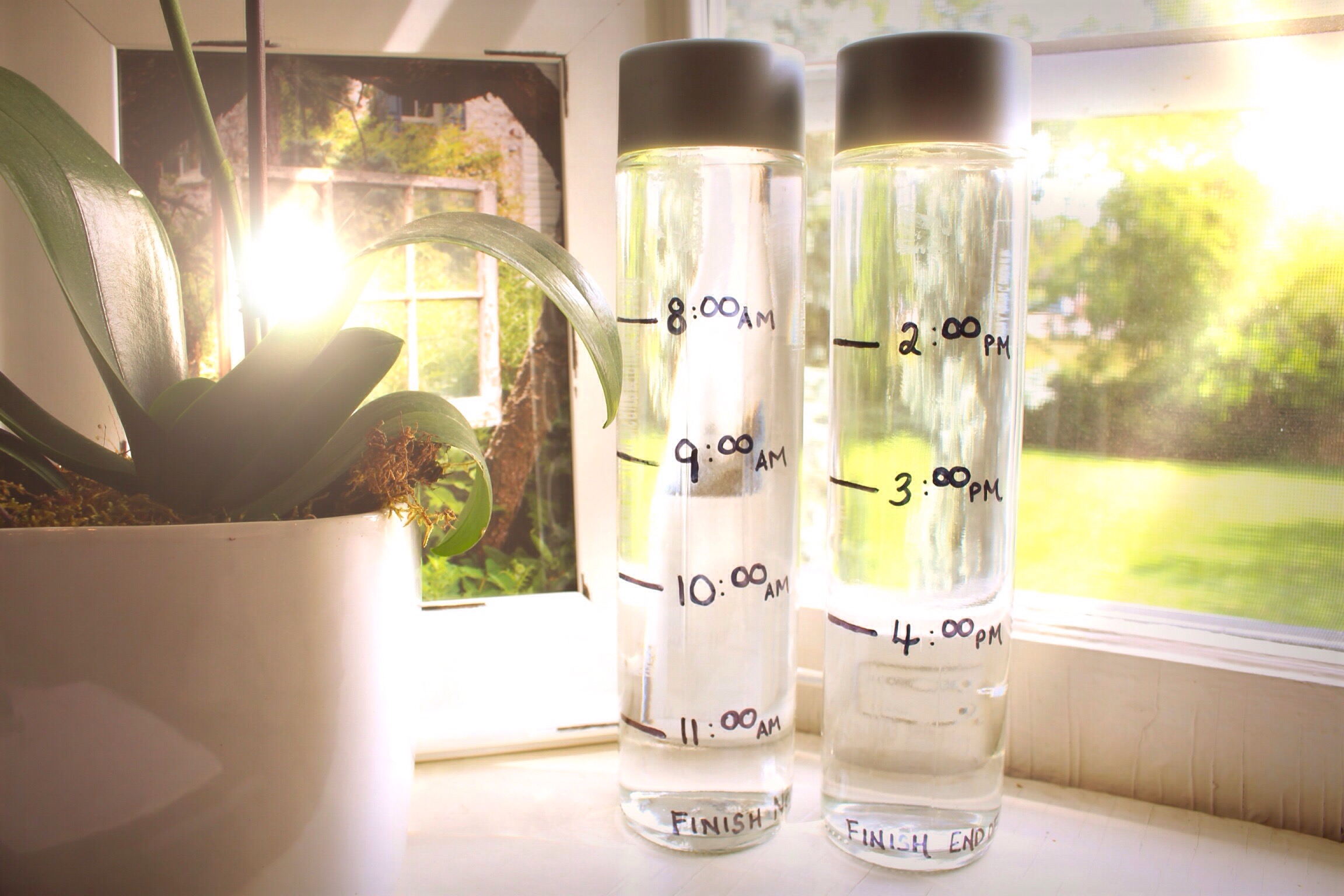
You’re probably wondering how much water is enough right about now. If you Google it, most answers range between 8-11 glasses per day. Many sources say most women need around eight 8-ounce glasses per day, this is about 2 liters or half a gallon. However, many experts also think water needs to be sipped throughout the day for adequate tissue hydration. So simply pounding a glass here and there isn’t ideal (remember the houseplant analogy). The idea of sipping water throughout the day also falls more in line with Eastern medicine theory. And, is a reason many Eastern cultures sip teas, broths, soups and herbal water infusions throughout the day. My beliefs on the topic are more in line with the philosophy of drinking water throughout the day. But still, the 8×8 rule I mentioned above is a one size fits all rule and as we know, women are not one size fits all! I’m all for making things simple. So, considering the human body is nearly 60% water content, what I tell women, is to aim to drink about half of their body weight in ounces per day. For example for someone who weighs 130 pounds, that’s 65 ounces. However, as discussed above, during exercise or menses water needs to be increased. How much it’s increased depends upon how much fluid a woman loses during these activities but I aim for an extra 20 ounces. Another thing to factor in is caffeine. If you’re a caffeine drinker, black tea, coffee and soda especially, drink an additional 20 ounces because these beverages are very dehydrating. Let’s add that scenario up. A woman who weighs 130 needs 65 oz water + 20 oz with menses or exercise + 20 for coffee intake, needs 105 oz/per day. The equation looks like this; 65+20+20= 105 ounces of water per day. To make this easy, be sure to know how many ounces the drink-ware you commonly use holds to keep track of consumption.
On a personal note, I wake up looking (like a Goddess) so much more bright eyed when my water intake is up. My skin looks plump with good coloring in my cheeks. I’ve gotten to the point where I’m keen to certain signals from my body when I’m dehydrated such as brain fog and a strange buzzing feeling under my skin. Perhaps this article has sufficiently encouraged you to want to up your intake. Just remember, by the time you actually feel thirsty or your lips are dry or peeling, you’re already dehydrated. Try to pay attention to little signals from your body like those, and to the way you feel as you slowly get your water intake up. You may find it helps alleviate some of the day to day symptoms you usually just push through or don’t relate to your body being thirsty.
